
How to Serve Someone Using Certified Mail (2025 Guide)
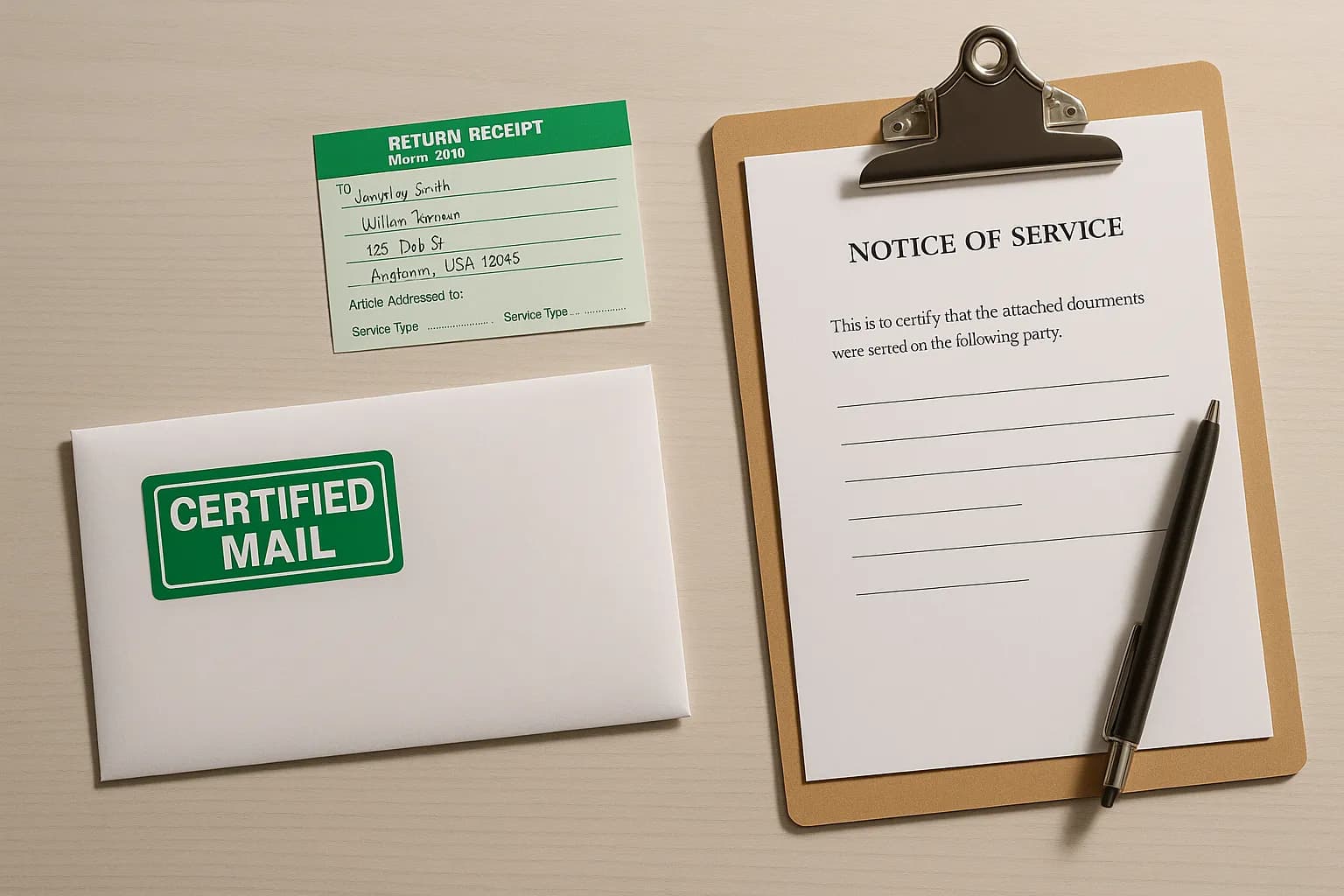
Important: Check Your Jurisdiction's Rules
Service requirements vary significantly by court and document type. Improper service can result in your case being dismissed. Always verify with your specific court whether certified mail service is permitted for your situation.
Quick Answer: Serving by Certified Mail
- Method: USPS Certified Mail with Return Receipt Requested
- Best for: Statutory notices, post-initial-service documents
- Usually NOT for: Initial service of lawsuit (requires personal service)
- After service: File Proof of Service with the court
Serving legal documents by certified mail is a formal process with specific requirements. When done correctly, service by certified mail creates legally valid proof that the recipient received your documents. This guide explains how to serve someone using certified mail, when it is allowed, and how to document proof of service by certified mail for court. For background on certified mail, see What Is Certified Mail?
Prefer to mail a letter online? Upload your PDF and we handle printing, postage, and USPS handoff.
In This Guide
When Certified Mail Service is Allowed
Certified mail service is typically permitted for:
Statutory Notices
- • Eviction notices (in many states)
- • Rent increase notices
- • Contract termination notices
- • Demand letters
- • Notice of intent to sue
- • Insurance claim notices
Documents After Initial Service
- • Motions and responses
- • Discovery requests
- • Notices of hearing
- • Briefs and memoranda
- • Any documents after a party has been personally served
Special Situations
- • Small claims court (many jurisdictions allow)
- • Out-of-state defendants (some jurisdictions)
- • When court grants permission for mail service
- • When defendant waives personal service
When Personal Service is Required
Certified mail alone is usually NOT sufficient for:
Typically Requires Personal Service
- • Initial service of a lawsuit (complaint and summons)
- • Restraining orders and protective orders
- • Subpoenas (in many jurisdictions)
- • Child custody and support documents (varies)
- • Divorce papers (initial filing)
Why Personal Service is Required
For initial service of a lawsuit, courts want certainty that the defendant actually knows about the case. Personal service (handing documents directly to the person) provides this certainty. Mail can be lost, misdelivered, or ignored.
Step-by-Step: Serving by Certified Mail
Step 1: Verify Mail Service is Permitted
- Check the applicable rules (court rules, statute, contract)
- Confirm certified mail is an accepted method
- Note any specific requirements (e.g., also send by regular mail)
Step 2: Prepare Documents
- Make copies of all documents to be served
- Keep originals for your records and court filing
- Ensure documents are complete and properly signed if required
Step 3: Address the Envelope
- Use the recipient's full legal name
- Use their last known address
- If serving an attorney, use attorney's address
- Include your return address
Step 4: At the Post Office
- Request "Certified Mail with Return Receipt Requested"
- Complete PS Form 3800 (certified mail receipt)
- Complete PS Form 3811 (green card/return receipt)
- Pay for postage and fees
- Get your receipt with tracking number
Step 5: Also Send Regular Mail (Recommended)
- Send a copy via regular first-class mail, same day
- This provides backup if certified is refused
- Some jurisdictions require both methods
Step 6: Track and Document
- Track delivery at USPS.com (see our certified mail tracking guide)
- Screenshot or print tracking showing delivery
- Save the green card when it returns
- Prepare Proof of Service for filing
Proper Addressing for Legal Service
Correct addressing is critical for valid service:
| Recipient Type | Address To |
|---|---|
| Individual | Full legal name at last known address |
| Individual with Attorney | Attorney's name at attorney's office address |
| Corporation | Registered agent or principal office |
| LLC | Registered agent or member/manager |
| Government Agency | Per specific rules (often specific designee) |
Important: Serve the Attorney, Not the Party
Once someone has an attorney in a case, you must serve documents on their attorney, not directly on the party. Serving the party directly when they have counsel can be improper and may be ignored.
Filing Proof of Service
After service, you typically must file a Proof of Service (also called Affidavit of Service or Certificate of Service) with the court.
Sample Proof of Service by Certified Mail
PROOF OF SERVICE BY CERTIFIED MAIL
I, [Name of Server], declare:
I am over 18 years of age and not a party to this action.
On [Date], I served the following documents:
[List each document served]
on the following person(s):
[Name]
[Address]
by placing true copies thereof enclosed in a sealed envelope with postage fully prepaid, addressed as indicated above, for collection and mailing by United States Postal Service Certified Mail, Return Receipt Requested.
Article Number: [Tracking Number]
The certified mail receipt (PS Form 3800) and return receipt (PS Form 3811) are attached hereto as Exhibit A.
I declare under penalty of perjury under the laws of [State] that the foregoing is true and correct.
Executed on [Date] at [City, State].
_________________________
[Signature]
[Printed Name]
Attach to your Proof of Service: Copy of certified mail receipt, copy of return receipt (green card) when you receive it, and tracking printout if available. For more on documenting your mailing, see our guide on how to prove you mailed something.
If Mail is Refused or Unclaimed
Sometimes recipients refuse certified mail or let it go unclaimed. Here's what to do:
If Marked "Refused"
In many jurisdictions, refused mail may still constitute valid service. The recipient had the opportunity to accept the documents and chose not to. Keep the returned letter (unopened) and tracking records showing the refusal. See our return to sender guide for more on handling refused mail.
If Marked "Unclaimed"
Unclaimed mail (recipient never picked it up) may or may not count as valid service depending on jurisdiction. Some courts accept it; others require additional steps. Check your local rules.
If Returned "Undeliverable"
If mail is returned as undeliverable (wrong address, no such address), you will need to find a correct address and try again, or use alternative service methods.
Why Sending Both Certified and Regular Mail Helps
By sending both certified and regular mail on the same day, you have backup evidence of service. If the certified letter is refused, the regular mail copy may have been delivered to the mailbox. This can strengthen your proof of service.
Common Service Scenarios
Eviction Notice
Certified mail allowed? Usually yes (varies by state)
Many states allow landlords to serve eviction notices by certified mail. Some require both certified mail and posting on the door. Check your state's landlord-tenant laws. See our eviction notice guide.
Demand Letter
Certified mail allowed? Yes
Certified mail is standard for demand letters. It provides proof you gave the recipient notice before filing suit. See our demand letter guide.
Small Claims Court
Certified mail allowed? Often yes
Many small claims courts allow plaintiffs to serve defendants by certified mail. Some require the court clerk to mail documents. Check your local rules.
Motion During Lawsuit
Certified mail allowed? Yes (after initial service)
Once all parties have been served with the initial complaint, subsequent documents can typically be served by mail.
Initial Lawsuit (Complaint)
Certified mail allowed? Usually no
Initial service of process typically requires personal service. However, some jurisdictions and some defendants (like out-of-state parties) may allow mail service with court permission.
Serve Documents by Certified Mail Online
Skip the post office. Upload your documents and we print and send them via USPS Certified Mail with Return Receipt. Same-day processing, full tracking, and documentation for your proof of service.
Send Certified Mail OnlineFAQs
Can I serve someone with a lawsuit using certified mail?
Initial service of a lawsuit (service of process) typically requires personal service, not certified mail. However, some jurisdictions allow service by certified mail in limited circumstances, such as small claims court or when the defendant waives personal service. Check your court's specific rules.
What if the person refuses to accept certified mail?
If certified mail is refused, the tracking will show "Refused." In many jurisdictions, refused mail may still count as effective service because the person had an opportunity to accept it. Keep the returned letter unopened and tracking records as evidence.
Do I need return receipt requested for legal service?
Yes, for legal service you should always use "Certified Mail with Return Receipt Requested." The return receipt (green card) provides proof of delivery with the recipient's signature, which is important evidence for court.
Who can serve documents by certified mail?
Rules vary significantly by jurisdiction. In some courts, any competent adult over 18 who is not a party can serve documents. Other jurisdictions require a sheriff, marshal, or licensed process server. Some courts allow parties themselves to serve subsequent documents (after initial service) but not the initial complaint. Always check your court's rules or consult an attorney.
Is certified mail service complete when I mail it or when they receive it?
This varies by jurisdiction. Some rules consider service complete upon mailing (postmark date), while others require actual receipt. Most jurisdictions add extra days to response deadlines when service is by mail to account for delivery time.
What address should I use for certified mail service?
Use the person's last known address. If they have an attorney in the case, serve the attorney's office address. For businesses, use the registered agent address or principal place of business.
Related Guides
- What Counts as Service by Mail
- How to Mail Legal Documents Correctly
- How to Mail Court Documents
- What is Certified Mail?
- How to Fill Out PS Form 3800
- How to Fill Out PS Form 3811 (Green Card)
Legal Disclaimer
This guide provides general information about serving documents by certified mail and is not legal advice. Service requirements vary significantly by jurisdiction and document type. Improper service can have serious consequences for your case. For advice about proper service methods in your specific situation, consult with a licensed attorney.
Tags: serve by certified mail, legal service, proof of service, serve documents by mail, certified mail service, legal notice delivery