
How to Prove You Mailed Something (2025 Guide)
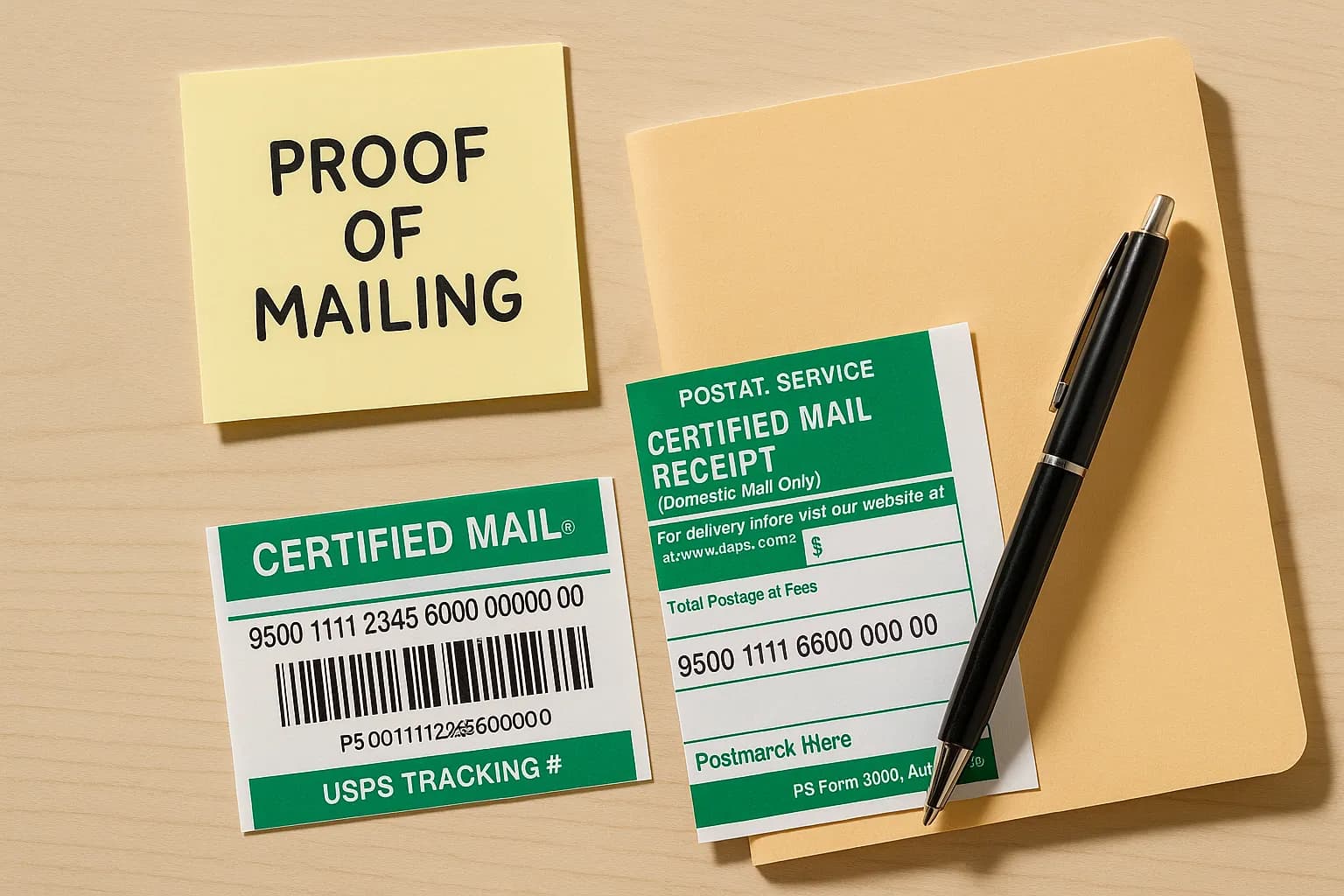
Quick Answer: Proving You Mailed Something
- Best method: USPS Certified Mail with Return Receipt
- What you get: Mailing receipt, tracking number, delivery confirmation, signed green card
- Budget option: Certificate of Mailing (proves mailing date only, no tracking)
- Keep everything: Receipts, tracking records, green card, copy of what you sent
Whether you are dealing with a legal matter, business dispute, or government deadline, having proof of mailing can be critical. "I sent it" means nothing without documentation. This guide explains the different ways to create proof that you mailed a letter or document, and what evidence is accepted in legal and business contexts. For more on certified mail, see our certified mail guide and certified mail tracking.
When you want to send a letter without going to the post office, upload your document and we take care of the rest.
In This Guide
Why You Need Proof of Mailing
Proof of mailing is important in many situations:
- Legal notices: Courts require proof that the other party received notice
- Deadline compliance: Proving you met a filing or notice deadline
- Contract requirements: Many contracts require written notice sent by specific methods
- Tax filings: Proving timely filing to the IRS or state agencies
- Insurance claims: Documenting that you submitted a claim
- Dispute resolution: Evidence that you attempted to resolve an issue
- Business records: Documentation for audits or compliance
The Problem with Regular Mail
Regular first-class mail provides no proof that you mailed anything. If someone claims they never received your letter, you have no way to prove otherwise. This can result in missed deadlines, dismissed legal cases, or lost disputes.
Types of Proof Available
USPS offers several services that provide different levels of proof:
| Service | Proves Mailing | Proves Delivery | Approximate Cost |
|---|---|---|---|
| Certificate of Mailing | Yes | No | ~$2 |
| Certified Mail | Yes | Via tracking | ~$5 |
| Certified + Return Receipt | Yes | Yes (signed) | ~$10 |
| Registered Mail | Yes | Yes (chain of custody) | ~$15+ |
| Priority Mail + Signature | Yes | Yes (signed) | Varies |
Prices are approximate and subject to change based on current USPS rates.
Certified Mail as Proof
Certified mail is the most common choice for proving mailing because it provides:
- PS Form 3800 receipt: Shows tracking number, date mailed, and recipient address
- Unique tracking number: Allows you to track the item online
- Delivery confirmation: USPS records when and where delivered
- Optional return receipt: Physical or electronic proof of delivery
What the Certified Mail Receipt (PS Form 3800) Shows
- • Date and time of mailing
- • Recipient's name and address
- • Unique tracking/article number
- • Your information as sender
- • USPS postmark
- • Fees paid
For detailed instructions, see our PS Form 3800 guide.
Certificate of Mailing (PS Form 3817)
A Certificate of Mailing is a budget-friendly option when you only need to prove you mailed something on a specific date, but do not need tracking or delivery confirmation.
What It Provides
- • USPS stamp showing date mailed
- • Record of recipient's address
- • Proof that item was accepted by USPS
What It Does NOT Provide
- • No tracking
- • No delivery confirmation
- • No signature proof
A Certificate of Mailing is useful when you need to prove you mailed something by a deadline (like a tax return) but do not need to prove the recipient received it. For mailing multiple pieces at once, see our PS Form 3665 guide (firm mailing book for bulk certificates of mailing).
Return Receipt (Green Card)
The Return Receipt (PS Form 3811) provides the strongest proof of delivery because it includes the recipient's signature.
What the Green Card Shows
- • Date of delivery
- • Recipient's signature (or signature of person who accepted)
- • Recipient's printed name
- • Address where delivered
- • Article number (matches your certified mail receipt)
Physical vs. Electronic Return Receipt
Physical (Green Card): Mailed back to you with signature. More traditional, accepted everywhere.
Electronic: Digital image available online. Slightly cheaper, faster, but not all courts may be familiar with it. For more information, see our electronic return receipt guide.
For instructions on filling out the return receipt, see our PS Form 3811 guide.
Tracking Records as Evidence
USPS tracking records can serve as evidence of both mailing and delivery:
- Tracking history: Shows every scan from acceptance to delivery
- Delivery confirmation: Date, time, and location of delivery
- Attempted delivery: Record if delivery was attempted but unsuccessful
- Status updates: "Delivered," "Refused," "Unclaimed," etc.
Important: Save Tracking Records
USPS tracking information is only available online for a limited time (typically 120 days for certified mail). Always screenshot or print tracking records while they are available. After that period, you may need to file a FOIA request to obtain historical records.
For more on tracking, see our certified mail tracking guide.
What Courts Accept as Proof
Courts generally accept the following as evidence of mailing. For guidance on mailing documents to courts specifically, see our guide on how to mail court documents.
Strongest Evidence
- • Certified mail receipt (PS Form 3800) + Return receipt (green card with signature)
- • Registered mail receipt + delivery confirmation
- • USPS tracking printout showing delivery
Acceptable Evidence
- • Certificate of Mailing (PS Form 3817)
- • Certified mail receipt without return receipt
- • Declaration or affidavit of mailing (sworn statement)
Weak or Insufficient
- • Regular postage receipt (only shows you paid postage)
- • Your own testimony without documentation
- • Copy of letter without mailing proof
Best Practices for Proof of Mailing
1. Use Certified Mail with Return Receipt
This is the gold standard. The combination of mailing receipt, tracking, and signed return receipt provides comprehensive proof that is accepted everywhere.
2. Keep Copies of Everything
Maintain copies of: the document you sent, mailing receipt, return receipt (green card), tracking printouts, and any related correspondence.
3. Save Tracking Records Promptly
Screenshot or print tracking information before it expires. USPS does not maintain online tracking indefinitely.
4. Send a Backup Copy
Send one copy via certified mail with return receipt, and another via regular first-class mail. If the certified letter is refused, the regular mail copy may still be delivered. For more on handling refused mail, see our return to sender guide.
5. Create a Mailing Log
Maintain a record of: date sent, recipient name and address, description of contents, tracking number, and date delivered. This helps if you need to reference old mailings.
Warning: What Does NOT Count as Proof
- Dropping mail in a mailbox: No proof whatsoever
- Handing to a postal carrier: No proof unless you get a receipt
- Regular mail receipt: Only proves you paid postage, not that you mailed to a specific address
- Your word: Without documentation, your testimony alone is weak
Get Proof of Mailing Automatically
Skip the post office. Upload your document and we send it via USPS Certified Mail with Return Receipt. You get digital copies of all receipts, tracking, and proof of delivery automatically saved to your account.
Send Certified Mail OnlineFAQs
What is the best way to prove you mailed something?
USPS Certified Mail with Return Receipt Requested provides the most comprehensive proof. You get a receipt showing date mailed and tracking number, tracking records showing delivery status, and a signed return receipt (green card) proving the recipient received it.
Is a receipt from the post office enough to prove mailing?
A basic postal receipt only shows you paid for postage. For legal purposes, you need a Certificate of Mailing (proves date mailed to specific address) or Certified Mail receipt (proves mailing plus provides tracking and delivery confirmation).
How do I prove delivery, not just mailing?
To prove delivery, use Certified Mail with Return Receipt (green card with recipient signature), Signature Confirmation service, or Registered Mail. These provide documented proof that someone at the address received the item.
What proof do courts accept for mailing?
Courts generally accept: Certified mail receipts and return receipts (green cards), USPS tracking records, Certificates of Mailing, and sworn declarations or affidavits of mailing. Certified mail with return receipt is the gold standard.
How long does USPS keep tracking records?
Online tracking is typically available for about 120 days for certified mail. After that, records may be available through FOIA requests, but this is not guaranteed. Always save tracking records while they are available.
What if the recipient refuses the certified mail?
Refusal is recorded in the tracking system. In many legal contexts, refused mail may still be considered "delivered" because the recipient had the opportunity to accept it. Keep the returned letter unopened as evidence.
Related Guides
- What is Certified Mail?
- How to Fill Out PS Form 3800
- How to Fill Out PS Form 3811 (Green Card)
- PS Form 3665: Certificate of Mailing
- How to Track Certified Mail
- Electronic Return Receipt
Legal Disclaimer
This guide provides general information about proving mailing and is not legal advice. Requirements for proof may vary by jurisdiction, document type, and specific circumstances. For advice about what proof is required for your specific legal matter, consult with a licensed attorney.
Tags: proof of mailing, prove you mailed something, certified mail proof, return receipt, certificate of mailing, legal proof of mailing