
PS Form 2976-A (CN 23): USPS Long Customs Declaration (2026 Guide)
Quick Answer: PS Form 2976-A
- Purpose: Detailed customs declaration for many international USPS packages
- Value threshold: Often higher-value shipments (typically over $400) and some Priority Mail International services regardless of value
- Also called: Customs Declaration CN 23
- Format: Full-page form with itemized listing capability
PS Form 2976-A, known as Customs Declaration CN 23, is the detailed USPS customs declaration form used for many international USPS packages that need a detailed customs declaration (often higher-value shipments, typically over $400, and some Priority Mail International services that require it regardless of value). Unlike the small adhesive PS Form 2976, this full-page form provides space to list multiple items with detailed descriptions, values, and quantities. This guide explains when you need PS Form 2976-A, how to fill it out correctly, and how it differs from other USPS customs forms. Always check current USPS rules for your mail class and destination.
In This Guide
What is PS Form 2976-A?
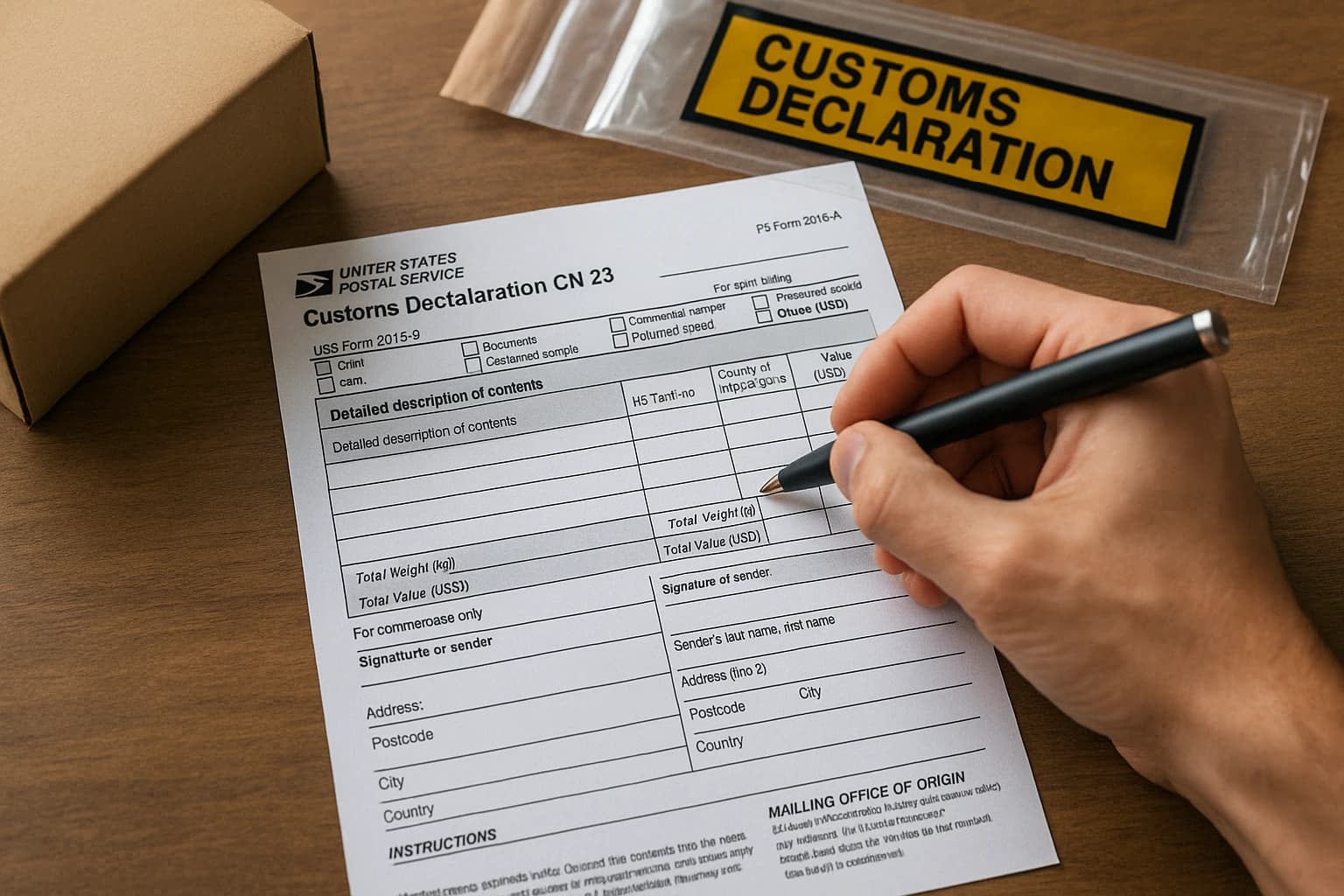
PS Form 2976-A is a full-page USPS customs declaration form (CN 23) used for international mail that requires detailed documentation. It is the same as Customs Declaration CN 23 in international postal systems. The form provides space to list multiple items individually, include detailed descriptions, declare accurate values, and provide additional information required by customs authorities. Unlike the small adhesive CN 22 label, PS Form 2976-A is printed on letter-sized paper and placed in a clear envelope pouch attached to the outside of your package.
Electronic Customs Forms (PS Form 2976-R)
USPS now generates customs forms electronically using PS Form 2976-R at the counter or through Click-N-Ship online. Older hand-written barcoded 2976-A forms are obsolete. At the post office, the clerk creates the form electronically based on your package information. For mailing at home, use Click-N-Ship which automatically generates the correct USPS international shipping form based on your service and destination.
When to Use PS Form 2976-A
You typically use PS Form 2976-A (the USPS customs declaration form CN 23) instead of PS Form 2976 when:
- Higher-value shipments: Merchandise shipments typically over $400 generally require the detailed CN 23 customs form, though exact thresholds depend on the USPS service and destination
- Package weight or size: Exceeds limits for CN 22 adhesive labels
- Multiple items requiring detailed inventory: Packages with many items that need itemized listing and won't fit on the small CN 22 label
- Commercial shipments: Items being sold commercially require detailed invoicing for USPS international package customs requirements
- Service requirements: Some USPS international shipping services (like certain Priority Mail International options) require CN 23 regardless of value—always check USPS rules for your specific service
- Country requirements: Some countries require CN 23 regardless of value (check USPS country restrictions)
Common use cases:
- Sending high-value gifts (jewelry, electronics, artwork)
- International business shipments with multiple products
- Packages containing items from multiple categories requiring separate listing
- Priority Mail International parcels with merchandise (some flat-rate formats have separate value limits—check USPS rules for your specific service)
How to Fill Out PS Form 2976-A: Step-by-Step
Section 1: Sender Information
- From (Sender's Name): Your full name or business name
- Business Name (if applicable): Company name for commercial shipments
- Street Address: Complete street address including apartment or suite number (see our envelope addressing guide for proper format)
- City, State, ZIP+4: Full mailing address with 9-digit ZIP if available (learn more about ZIP+4 format)
- Country: United States
- Phone Number: Contact number with country code
Section 2: Recipient Information
- To (Addressee's Name): Recipient's full legal name
- Business Name (if applicable): Company name if shipping to a business
- Street Address: Complete delivery address in local format
- City, Province/State, Postal Code: Complete destination address
- Country: Full country name
- Phone Number: Recipient contact number (helps with customs clearance)
Section 3: Detailed Description of Contents
This is the most important section. List each item individually:
- Quantity: Number of each item
- Detailed Description: Specific description (not just "clothing" but "2 cotton T-shirts, size L")
- Weight (lbs and oz): Weight of each line item
- Value (USD): Fair market value in US dollars for each item type
- Country of Origin: Where the item was manufactured (usually USA)
- HS Tariff Number (optional but recommended): Harmonized System classification code
Section 4: Totals
- Total Weight: Sum of all items in lbs and oz
- Total Value: Sum of all item values in USD
Section 5: Type of Shipment
Check the appropriate box:
- Gift: Items sent as gifts with no commercial value
- Merchandise: Items being sold or for commercial use
- Sample: Product samples for business evaluation
- Documents: Papers with no commercial value
- Other: Specify if none of the above apply
Section 6: Certification and Signature
- Read the certification statement certifying accuracy of contents and value
- Sign your name
- Date the form
Section 7: Attach to Package
Place the completed form in a clear customs pouch (provided by USPS) and attach it securely to the outside of your package. Do not fold or obscure any information.
Listing Multiple Items on PS Form 2976-A
PS Form 2976-A provides space for multiple line items. Best practices:
- Group similar items: Combine identical items into one line (e.g., "3 books, total value $45" instead of listing each book on a separate line)
- Be specific with descriptions: "Cotton dress shirt, blue, size M" not just "shirt"
- Individual values: Show the total value for grouped items on one line
- Use additional sheets if needed: If you have more items than fit on one form, attach a typed or printed list
Customs Tip
The more detailed and accurate your descriptions, the faster customs clearance will be. Vague descriptions cause delays and inspections.
Send International Mail Online
Skip the customs paperwork. The Letter Pilot handles international mailing with automatic customs documentation. Upload your letter and we mail it next business day with tracking.
Send a Letter Online →PS Form 2976-A vs PS Form 2976: Which to Use?
Choosing the correct customs form is important for smooth delivery:
| Feature | PS Form 2976 (CN 22) | PS Form 2976-A (CN 23) |
|---|---|---|
| Value limit | Generally used for lower-value shipments (often under $400, depending on service and country) | Used for higher-value or more detailed shipments when required by USPS service or destination country |
| Format | Small adhesive label | Full-page form in pouch |
| Item listing | Brief description, limited space | Detailed itemized list |
| Best for | Small packages, gifts under $400 | High-value or commercial shipments |
| Multiple copies | Single label | Often requires duplicates for customs |
See our complete comparison of USPS customs forms for help choosing the right form.
Common Mistakes to Avoid
- Using 2976 when 2976-A is required: Higher-value or complex shipments may require the detailed form depending on USPS service and destination rules
- Incomplete item descriptions: "Electronics" is not sufficient—specify "Laptop computer, Dell model XYZ"
- Incorrect total values: Double-check math when adding up multiple items
- Missing recipient phone number: Helps customs contact recipient for clearance issues
- Not keeping a copy: Keep a photocopy or scan for your records
- Prohibited items: Check USPS country restrictions before mailing—some items cannot be sent regardless of documentation
FAQs
What is PS Form 2976-A used for?
PS Form 2976-A (Customs Declaration CN 23) is used for higher-value international packages, detailed commercial shipments, or when USPS service or destination country requires a CN 23 customs form. It provides space for itemized listings and detailed descriptions.
What is the difference between PS Form 2976 and 2976-A?
PS Form 2976 (CN 22) is a short customs form generally used for lower-value shipments (often under $400, depending on service and country). PS Form 2976-A (CN 23) is a detailed form used for higher-value or more complex shipments when required by USPS service or destination country. 2976-A provides more space for multiple items and detailed descriptions.
When is PS Form 2976-A required?
PS Form 2976-A is required for higher-value international shipments (commonly over $400, though exact thresholds vary by USPS service and destination), packages too large for CN 22 labels, commercial shipments requiring detailed invoices, or when required by the destination country customs regulations or USPS service selected.
Where do I get PS Form 2976-A?
USPS now generates customs forms electronically (often using PS Form 2976-R at the counter or Click-N-Ship online). Older hand-written barcoded 2976-A forms are obsolete. At the post office, the clerk will create the form electronically. For mailing at home, use Click-N-Ship which generates the correct customs form automatically based on your service and destination. You will also need a clear customs pouch to attach it to your package (available at post offices).
Can I use PS Form 2976-A for packages under $400?
Yes. You can use 2976-A for any value package if you prefer detailed documentation or if the package has many items. You cannot use 2976 (CN 22) for packages over $400, but you can use 2976-A for any value.
How many copies of PS Form 2976-A do I need?
Typically one copy in the customs pouch on the outside of the package. Some countries or commercial shipments may require additional copies inside the package or separate commercial invoices. Check destination country requirements.
What is an HS Tariff Number and do I need it?
Harmonized System (HS) tariff numbers are international product classification codes. They are optional for personal shipments but recommended for commercial shipments to speed customs clearance and determine duties.
Does the recipient pay customs duties on PS Form 2976-A packages?
Possibly. Destination country customs may assess import duties and taxes based on the declared value and item type. The recipient typically pays these fees. Marking items as "Gift" may reduce or eliminate duties in some countries.
What is the difference between PS Form 2976-A and PS Form 2976-R?
PS Form 2976-R is the electronic intake worksheet USPS now uses to generate customs forms at the counter or through Click-N-Ship online. It's not the actual customs declaration—it's the system that creates the declaration. When you provide information via 2976-R, the system automatically prints either a CN 22 or CN 23 customs declaration (2976-A when detailed) based on your package details, service, and destination. The final printed CN 23 form is what you attach to your package.
Do I still need a clear customs pouch for electronically-generated forms?
Yes. Whether the customs form is hand-written or electronically generated via PS Form 2976-R, you still need to place the completed CN 23 form in a clear customs pouch and attach it securely to the outside of your package. The pouch protects the form during transit and keeps it visible for customs officials. USPS provides these pouches at no cost at post office counters.
Related Guides
- PS Form 2976: Short Customs Form (CN 22)
- PS Form 2976-B: Express International Customs Form
- Which USPS Customs Form Do You Need?
- How to Address an Envelope for International Mail
- International Mail Tracking
Tags: ps form 2976-a, customs declaration cn 23, detailed customs form, international package customs, usps customs form over 400