
Apt vs Unit vs Suite: USPS Secondary Address Format Examples
Early in our journey with The Letter Pilot, address formatting was one of our biggest pain points. We built functionality to format addresses automatically and validate them against USPS standards, but in some cases it dropped apartment numbers, suite numbers, building numbers, and other important details. We had unhappy customers, and honestly, that was our fault. We did not understand secondary address information well enough at the time. We know much more about the process now, although it can still be confusing. I still find myself doing a double take when I see something like a floor number instead of an apartment, or a PMB instead of a PO Box. Hopefully, this guide can pass along what we have learned about how these address details work.
Address Formatting Basics
Here are the basics: start with the street address, then put the apartment, suite, unit, or building information after it on the same line. A complete address with secondary information usually follows this format:
Standard Format
RECIPIENT NAME
STREET NUMBER STREET NAME APT/STE/UNIT/BLDG NUMBER
CITY STATE ZIP
What USPS prefers
- Place the apartment, suite, unit, floor, or building information at the end of the street-address line.
- Use an approved designator such as APT, STE, UNIT, FL, or BLDG.
- Use uppercase letters when practical. USPS prefers uppercase, although readable lowercase text is acceptable.
- Punctuation can be omitted. USPS shows unpunctuated addresses as preferred, but punctuated addresses can still be acceptable. We created an address standardizer tool to help format the address for you.
What to avoid
- Do not put secondary information below the city, state, and ZIP Code line.
- Do not leave out the apartment or unit number when the address requires one. Once you have the complete address, use the address validator to check it, or use the ZIP+4 lookup when you specifically need the nine-digit ZIP Code.
- Do not use # as a substitute when the correct designator, such as APT or STE, is known.
Standard USPS Address Designators
Things can get a little confusing when you see PMB or other less-common designators. We created this quick-reference chart to help you decide what to use for the letter you're trying to send.
| Full Name | Abbreviation | What it identifies |
|---|---|---|
| Apartment | APT | Apartment number |
| Suite | STE | Suite number |
| Unit | UNIT | Unit number |
| Floor | FL | Floor number |
| Building | BLDG | Building identifier |
| Room | RM | Room number |
| Department | DEPT | Department identifier |
| Space | SPC | Space number |
| Lot | LOT | Lot number |
| # (Number) | # | Fallback when the correct designator cannot be determined |
| Private Mailbox | PMB | Private mailbox number at a commercial mail receiving agency |
Which Address Designator Should You Use?
Use the designator that belongs to the actual address. If the apartment complex identifies the address as APT 5, write APT 5. If the building uses UNIT 5, write UNIT 5. The same idea applies to STE, FL, BLDG, RM, and the other approved designators.
USPS says the pound sign should not replace a known designator such as APT or STE. Use # only when the proper designator cannot be determined, and include a space before the number, as in # 5.
PMB is the important exception. A private mailbox at a commercial mail receiving agency must use PMB or # followed by the mailbox number. It cannot be relabeled as APT, STE, or PO BOX.
Where to Put the Apartment Number
Here are some common placement mistakes I see when people mail through our service. Our system now catches these kinds of errors and generally formats the address correctly. If it cannot confidently fix an address, we reach out to the customer and apply a manual correction on their behalf. These are simply a few things to keep in mind when sending your letters.
✅ Preferred: Same Line as Street Address
JOHN SMITH
123 MAIN STREET APT 4B
NEW YORK NY 10001
This is the USPS-preferred format.
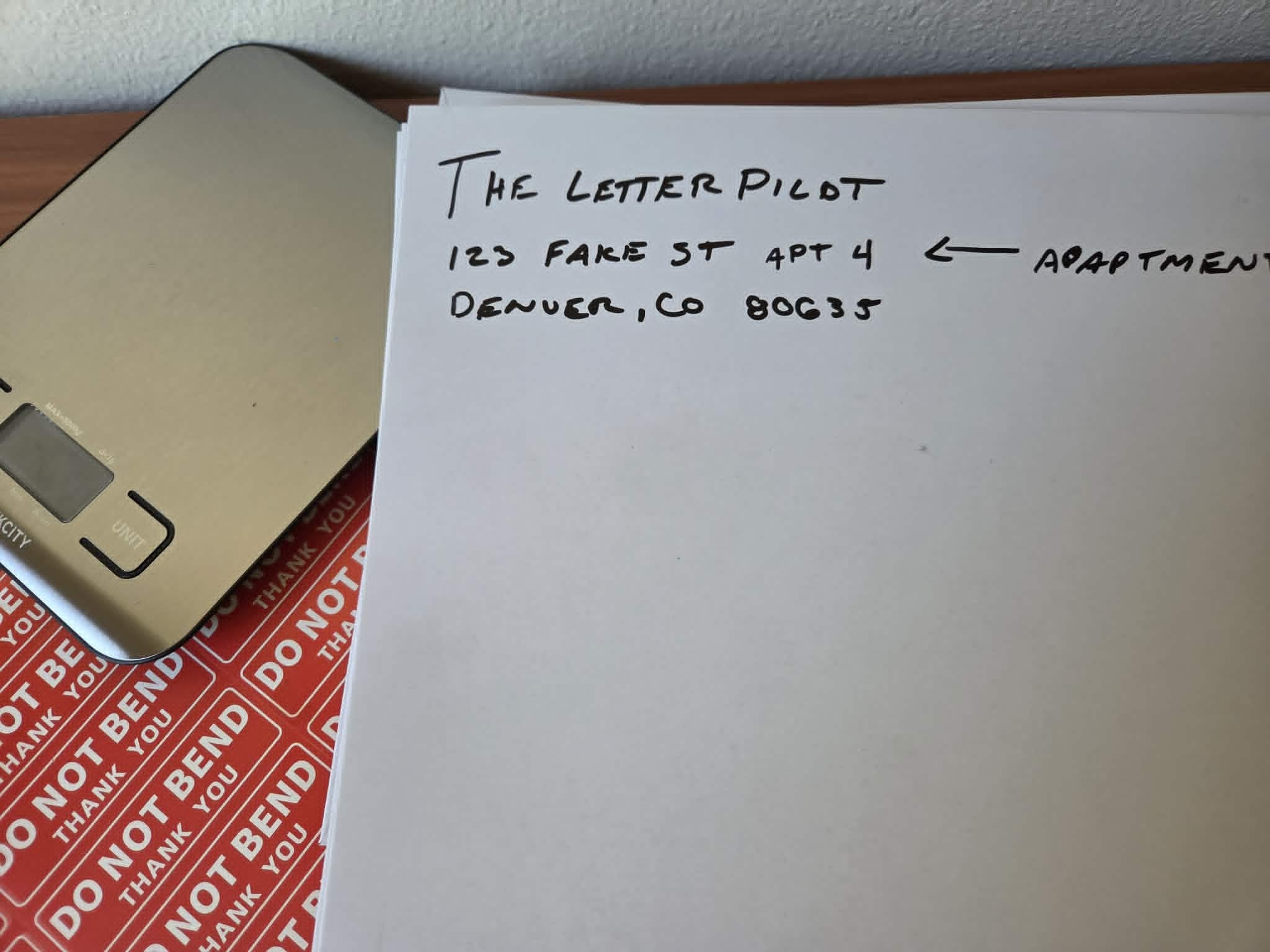
✅ Acceptable: Line ABOVE Street Address
JOHN SMITH
APT 4B
123 MAIN STREET
NEW YORK NY 10001
Use this only if the address is too long for one line.
Not preferred: Line Below Street Address
JOHN SMITH
123 MAIN STREET
APT 4B ← Wrong position!
NEW YORK NY 10001
This is not the USPS-preferred placement. If the apartment information will not fit on the street-address line, place it immediately above the street address instead.
Correct Examples by Type
Here are correctly formatted examples for different situations:
Apartment
JANE DOE
456 OAK AVENUE APT 12
CHICAGO IL 60601
Suite
ACME CORPORATION
ATTN JOHN SMITH
100 CORPORATE BLVD STE 500
DALLAS TX 75201
Unit
MIKE JOHNSON
789 MAPLE COURT UNIT 3
SEATTLE WA 98101
Building + Apartment
SARAH WILLIAMS
200 PARK PLACE BLDG C APT 301
BOSTON MA 02101
Floor Only
ABC COMPANY
555 BUSINESS CENTER FL 12
LOS ANGELES CA 90001
Mobile Home
BOB MILLER
123 TRAILER PARK RD LOT 45
PHOENIX AZ 85001
Common Mistakes to Avoid
Compare these commonly written addresses with the USPS-standardized format:
| Less standardized | USPS-standardized format | Why |
|---|---|---|
| 123 Main St. Apt. #4 | 123 MAIN ST APT 4 | Removes punctuation and the unnecessary # |
| 123 Main Street Apartment Four | 123 MAIN ST APT 4 | Use abbreviations and numbers |
| 123 Main St New York NY 10001 Apt 4 | 123 MAIN ST APT 4 NEW YORK NY 10001 | Apt goes BEFORE city line |
| 123 Main St, Suite 5 | 123 MAIN ST STE 5 | Uses the USPS abbreviation and omits unnecessary punctuation |
Don't Forget Your Apartment Number
This is the single biggest mistake I see. The street address itself may be valid, so an address-validation system can recognize the building without realizing that an apartment number is missing. The mail then reaches a building with multiple doors or mailboxes, and the carrier has no reliable way to know which one belongs to the recipient.
USPS says secondary information such as an apartment or suite designator is required when the delivery location contains one. Without it, the mail may be delayed or returned because the address is not specific enough for delivery.
Special Cases
I have also run into confusing secondary addresses in my own life. It can be incredibly frustrating when an address looks correct but mail still does not arrive. I once lived in a condo complex at an address we will call 2441 W 3RD ST. The complex had two separate buildings, and each building had its own UNIT 4. My address was in Building B, so the complete secondary address information was BLDG B UNIT 4, not UNIT 4B. Leaving out the building identifier could send someone to the wrong side of the complex. Situations like this can get confusing quickly, so let's cover a few of the less obvious scenarios below.
Letter + Number Combinations (APT 4B)
Preserve the complete identifier assigned to the address. If it is APT 4B, do not shorten it to APT 4 or add a space between the 4 and B. The same principle applies to identifiers such as STE 100A or UNIT 12C.
Multiple Designators (Building + Apt)
An address may contain more than one secondary element, such as BLDG C and APT 301. Preserve the complete address supplied by the recipient or a validated address record rather than inventing an order. USPS Appendix C2 lists the approved designators.
Frequently Asked Questions
Where does the apartment number go in an address?
USPS prefers the apartment number at the end of the street-address line, as in 123 MAIN ST APT 4B. If the complete address will not fit on one line, place the apartment information on the line immediately above the street address.
What if the address is really long?
USPS prefers the secondary unit at the end of the delivery-address line. If the complete address will not fit there, place the secondary information on the line immediately above the street address.
What is the correct abbreviation for apartment?
APT is the USPS standard abbreviation for apartment. USPS lists other specific designators, including STE, UNIT, FL, and BLDG. Use the one that belongs to the actual address rather than swapping one term for another.
Can I use # instead of APT?
No. Use APT followed by the apartment number. Replacing APT with the # symbol is a common misconception and is not the USPS-preferred format.
Is a private mailbox the same as a PO Box?
No. A private mailbox is provided by a commercial mail receiving agency and is written with PMB or #. USPS specifically says it may not be represented as a PO Box. A USPS PO Box is addressed with PO BOX followed by its box number.
Sources
- USPS Publication 28, Section 212: Format
- USPS Publication 28, Section 213: Secondary Address Unit Designators
- USPS Publication 28, Section 222: Punctuation
- USPS Publication 28, Section 281: PO Box Addresses
- USPS Publication 28, Section 285: Private Mailbox Addresses
- USPS Publication 28, Appendix C2: Secondary Unit Designators
Ready to mail your letter? Upload your letter, and we'll print it, address the envelope, apply postage, and send it through USPS.
More addressing guides
USPS guide
How Much Does a PO Box Cost? USPS, UPS & Virtual Mailbox Prices (2026)
Compare 2026 USPS PO Box rates by size, published UPS Store mailbox prices, and virtual mailbox plans. Find exact local prices and sources.
Read guide
USPS guide
USPS General Delivery: Address Format, Rules & Pickup
Learn how USPS General Delivery works, who can use it, how to find a participating Post Office, and the address format and ID needed to pick up your mail.
Read guide
USPS guide
Does UPS Deliver to PO Boxes? Rules & Alternatives
Does UPS deliver to PO boxes? Learn when UPS Ground Saver or USPS Street Addressing works, plus alternatives for receiving your packages.
Read guide
USPS guide
How to Address a PO Box on an Envelope
Put the recipient name first, the PO Box number on the next line, and the city, state, and correct PO Box ZIP Code on the final line.
Read guide
USPS guide
C/O (In Care Of) vs ATTN on Mail
Use c/o when another person or business receives mail on someone’s behalf. Use ATTN when mail has reached the correct organization but needs to be routed internally.
Read guide