
What Does ATTN Mean on Mail? How to Use Attention Lines Correctly
An ATTN (Attention) line helps ensure your mail reaches a specific person within an organization or household. This guide covers proper formatting, placement, and when to use attention lines versus other addressing options.
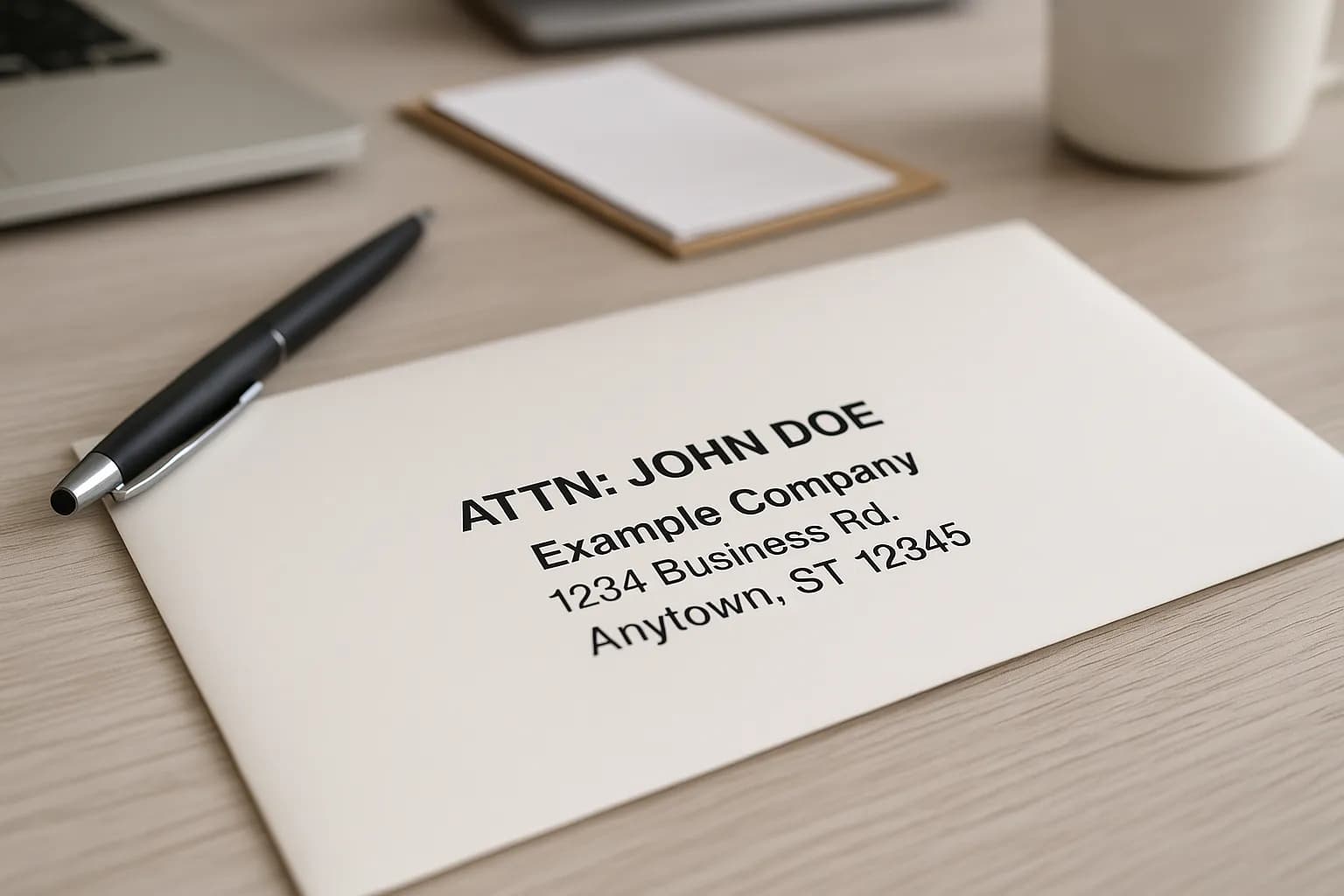
Quick answer
ATTN is short for "attention." It tells USPS to route the letter to a specific person at a business or organization. Write it on the first line of the address, above the company name: ATTN: Jane Smith.
The information in this guide is for educational purposes only. The Letter Pilot does not guarantee USPS delivery times, routing, or processing speed. All mail is handled solely by the United States Postal Service, and actual delivery times may vary.
Delivery timelines and tracking information are provided by USPS and are not controlled by The Letter Pilot.
Prefer to mail a letter online? Upload your PDF and we handle printing, postage, and USPS handoff.
What Is an ATTN Line?
ATTN stands for "Attention" and is used in mail addressing to direct a letter or package to a specific person within an organization, business, or household. The attention line tells mail handlers that while the mail is addressed to a company or location, it should be delivered to a particular individual.
Using an attention line is especially important when sending mail to large organizations where general mail might be opened by administrative staff or routed through a mailroom. The ATTN line helps ensure your correspondence reaches the intended recipient. Note that ATTN is not required by USPS—automated mail sorting relies primarily on the city, state, and ZIP code lines—but it serves as a helpful routing aid for humans in the mailroom or office who handle internal distribution.
Both "ATTN:" and the full word "Attention:" are acceptable formats. The abbreviated "ATTN:" is more common in business correspondence and saves space on the envelope.
When to Use an Attention Line
Attention lines are appropriate in several situations:
- Business correspondence: When sending mail to a specific employee at a company
- Government agencies: When directing mail to a particular department or official
- Legal documents: When ensuring legal notices reach the correct person
- Shared residences: When multiple people live at the same address
- PO Boxes: When a PO Box is shared by multiple individuals or a business
- Apartment buildings: When the recipient's name differs from the name on the mailbox
If you are sending mail to someone at their own home where they are the primary resident, an attention line is typically not necessary. Simply address the envelope to them directly.
Where to Put the ATTN Line on an Envelope
According to USPS addressing standards, the attention line should be placed on the first line of the address block. If you're wondering how to write an attention line on an envelope, here's the standard order:
ATTN: [RECIPIENT NAME]
[ORGANIZATION NAME]
[STREET ADDRESS]
[CITY, STATE ZIP CODE]
Key placement rules to follow when addressing your envelope:
- The ATTN line goes above the organization or business name
- Keep all address lines left-aligned
- Use all capital letters for better mail processing (though mixed case is also accepted)
- Do not place the ATTN line below the street address
- Include the colon after ATTN: for clarity
TL;DR: Put ATTN: on the first line, above the business name, and keep the rest of the address in standard USPS format.
ATTN Line Format Examples
Here are sample ATTN line formats you can use as templates when addressing your envelope. Notice that all examples use "ATTN:" on the first line with the rest of the address following standard USPS format.
Business Address with ATTN Line
ATTN: SARAH JOHNSON
ACME CORPORATION
123 BUSINESS PKWY STE 400
CHICAGO IL 60601
Government Agency
ATTN: RECORDS DEPARTMENT
CITY CLERK'S OFFICE
200 E MAIN ST
SPRINGFIELD IL 62701
Shared Residence
ATTN: MICHAEL CHEN
THE SMITH RESIDENCE
456 OAK LANE
PORTLAND OR 97201
PO Box
ATTN: MEMBERSHIP COORDINATOR
LOCAL ROTARY CLUB
PO BOX 789
AUSTIN TX 78701
Using Full "Attention" Word
ATTENTION: DR PATRICIA WONG
LAKESIDE MEDICAL GROUP
890 HEALTH CENTER DR
SEATTLE WA 98101
ATTN vs C/O: What's the Difference?
Many people are unsure whether to write ATTN or C/O on their envelope. While both help direct mail to specific individuals, they serve different purposes:
| Feature | ATTN (Attention) | C/O (Care Of) |
|---|---|---|
| Meaning | Direct this mail to a specific person | This person is receiving mail through another party |
| Typical Use | Business correspondence to employees | Someone staying at another's address |
| Placement | First line of address block | After recipient's name |
| Example | ATTN: John Smith ABC Company | John Smith C/O Jane Doe |
Use ATTN when: The recipient works at or has an official connection to the organization or address.
Use C/O when: The recipient is temporarily staying with someone, using another person's address for mail, or receiving mail through an agent or representative.
Common Mistakes to Avoid
- Placing ATTN on the wrong line: The attention line should always be the first line of the address block, not buried in the middle or at the end.
- Using ATTN when C/O is appropriate: If someone is staying at another person's home or receiving mail through an agent, use C/O instead of ATTN.
- Omitting the organization name: When using ATTN for business mail, still include the company name on the second line to ensure proper routing. This is especially important for certified mail where accurate delivery is critical.
- Placing ATTN in the return address: The ATTN line belongs only in the recipient's address, not in your return address.
- Using both ATTN and C/O: Choose one or the other based on the situation. Using both is redundant and can cause confusion.
- Forgetting the name after ATTN: The attention line must include the recipient's name or department (e.g., "ATTN: Billing Department").
Frequently Asked Questions
What does ATTN mean on mail?
ATTN stands for "Attention" and is used to direct mail to a specific person within an organization. It helps ensure the letter reaches the intended recipient rather than being opened by general mail handlers.
Where does the ATTN line go on an envelope?
The ATTN line should be placed on the first line of the address block, above the organization name. For example: ATTN: John Smith, followed by the company name on the next line, then the street address, and finally the city, state, and ZIP code.
Should I use ATTN or Attention?
Both "ATTN:" and "Attention:" are acceptable. USPS recognizes both formats. The abbreviated "ATTN:" is more common in business correspondence and saves space on the envelope.
Can I use ATTN for residential addresses?
Yes, ATTN lines can be used for residential addresses when multiple people live at the same address. This is common when sending mail to a specific person at a family home or shared residence.
Is C/O the same as ATTN?
No, they serve different purposes. ATTN (Attention) directs mail to a specific person at their own address or business. C/O (Care Of) indicates the recipient is staying at someone else's address or receiving mail through another party.
Do I need a colon after ATTN?
While not strictly required, using a colon after ATTN (ATTN:) is the standard format and makes the address easier to read. Most business correspondence follows this convention.