How to Avoid Mail Being Returned to Sender
Quick Answer: Prevent Returned Mail
- Verify addresses using USPS Address Verification tool
- Use proper formatting: Name, Street + Apt, City State ZIP
- Apply correct postage by weighing mail first
- Include return address in upper left corner
- Confirm recipient names match mailbox/PO Box authorization
Returned mail costs time, money, and can cause missed deadlines. USPS returns mail for various reasons including incorrect addresses, insufficient postage, and recipient issues. Understanding why USPS returns mail and how to prevent returned mail saves frustration and ensures your important correspondence reaches its destination. This guide covers USPS return to sender codes, the most common causes, and how to avoid them.
In This Guide
Common Reasons Mail Is Returned
USPS marks returned mail with specific codes indicating the reason. For the full return to sender process, the most common USPS return to sender codes are:
- Insufficient Address: Missing apartment number, wrong street name, or incomplete information
- No Such Number: The street number does not exist
- No Such Street: The street name does not exist in that ZIP Code
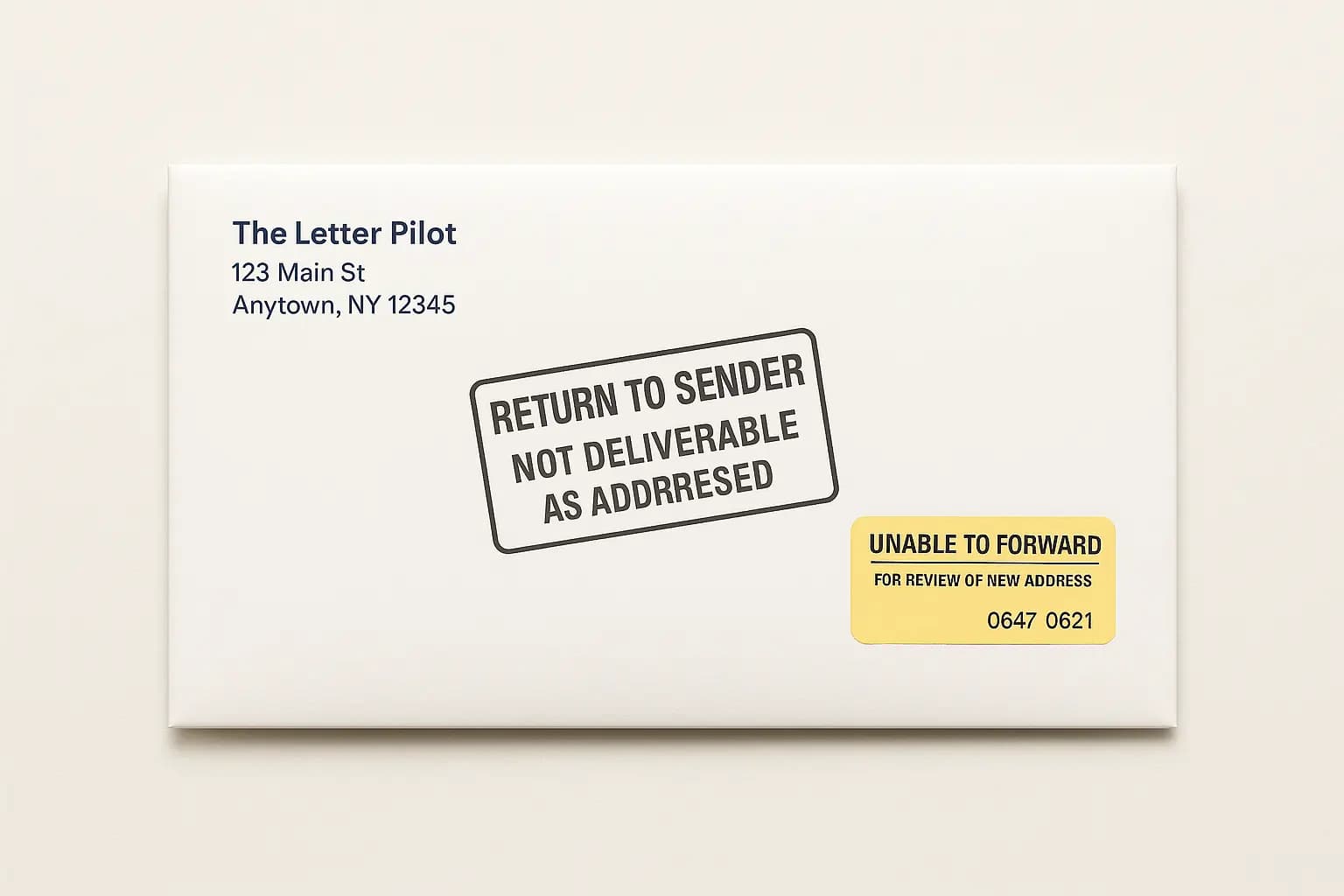
- Not Deliverable as Addressed (NDAA): General address problem preventing delivery
- Attempted Not Known: Recipient name not recognized at that address
- Moved Left No Address: Recipient moved without forwarding
- Refused: Recipient rejected the mail
- Insufficient Postage: Not enough stamps for the weight or service
- Unable to Forward: Forwarding order expired or not on file
Address Verification Before Mailing
Verify addresses before mailing to catch errors and prevent returned mail:
- Use our free Address Validator to verify full addresses
- Use our ZIP Code Validator to confirm ZIP codes match cities
- Include apartment, suite, or unit numbers
- Verify PO Box numbers with the box holder
- For business mail, confirm the company is still at that address
- Ask recipients to confirm their current mailing address
Proper Address Formatting
USPS prefers addresses formatted as:
- Line 1: Recipient name
- Line 2: Street address (number, street name, apt/suite)
- Line 3: City, State ZIP Code
Formatting tips to avoid undeliverable as addressed mail:
- Use standard abbreviations (ST, AVE, BLVD, APT, STE)
- All caps improve machine readability
- No punctuation is preferred
- Include directionals (N, S, E, W, NE, SW) when part of the address
- Put secondary unit info (Apt, Suite) on the same line as street address if possible
For detailed guidance, see our how to address an envelope guide.
Ensuring Correct Postage
Insufficient postage is a preventable reason for returns:
- Weigh your mail before adding stamps
- First Class letters: 1 oz limit for standard stamp; add postage for additional ounces
- Large envelopes (flats) cost more than letter-size mail
- Square envelopes require a non-machinable surcharge in addition to regular postage
- Rigid or uneven thickness requires extra postage
- When in doubt, take it to the post office for weighing
Dealing with Recipient Moves
Mail is returned when recipients move without forwarding:
- Confirm addresses annually for regular correspondents
- For business mail, use address update services
- USPS forwards First Class Mail for 12 months after a change of address is filed (magazines and periodicals forward for 60 days only)
- After 12 months, forwarded mail is returned if no permanent update is filed
- Add "Address Service Requested" to get updated addresses from USPS (fee applies)
Learn more in our USPS change of address guide.
Name and Recipient Issues
Mail may be returned if the recipient is not recognized. Understanding "Attempted Not Known USPS" codes helps prevent this:
- Use the recipient's full legal name as it appears on their mailbox
- For married recipients, confirm which name they use for mail
- Businesses must be addressed to the registered business name or a known employee
- For c/o addresses, ensure the c/o party will accept mail for the recipient
- PO Box mail must match an authorized name on the box
Return Address Best Practices
Always include a return address so undeliverable mail comes back:
- Place return address in the upper left corner of the envelope
- Include your full name, street address, city, state, and ZIP
- Use a consistent return address so you receive returned mail
- Without a return address, undeliverable mail goes to the USPS Mail Recovery Center in Atlanta
Special Situations
Military mail (APO/FPO/DPO):
- Use exact format provided by service member
- Include rank and unit information exactly as specified
- Verify deployment location has not changed
International mail:
- Include country name in English on the last line
- Follow destination country's address format
- Use correct international postage
- Customs forms required for packages
Rural addresses:
- Rural routes may have converted to 911 street addresses
- Verify current address format with recipient
- Some areas use both formats; street address is preferred
What to Do When Mail Is Returned
- Read the USPS marking to understand why it was returned
- Verify the address with the recipient before resending
- Correct any postage issues
- If address was correct, contact the recipient to confirm they still receive mail there
- For repeated returns, consider calling USPS or the destination post office
For more details on what happens to returned mail, see our return to sender guide.
Never Worry About Returned Mail Again
We verify addresses, apply correct postage, and mail next business day if submitted before 8 PM ET.
Send a Letter Online →FAQs
How long does it take for returned mail to come back?
Typically 2 to 3 weeks, depending on where it was returned from. International returns take longer.
Can I resend mail that was returned?
Yes, but you must correct the issue that caused the return and add new postage. The original postage is consumed.
What does "Attempted Not Known" mean?
The carrier attempted delivery but the recipient name is not recognized at that address. The person may have moved or never lived there.
Why was my mail returned even though the address is correct?
Possible reasons include: the name does not match an authorized recipient, the mailbox is full, or there was a temporary hold on mail. Contact the recipient to investigate.
Can I track returned mail?
Only if the original mail had tracking (certified mail, Priority Mail). Regular First Class returns are not tracked.
What happens to returned mail without a return address?
It goes to the USPS Mail Recovery Center in Atlanta, where staff try to identify the sender. Items are typically held for a limited time (often up to 90 days) and then may be recycled, donated, auctioned, or destroyed if they cannot be delivered or claimed.
Does certified mail get returned?
Yes. If the recipient cannot be reached after multiple attempts, certified mail is returned to the sender. You can track the return journey.
Related Tools & Guides
- Address Validator Tool – Verify addresses before mailing
- ZIP Code Validator Tool – Check if a ZIP code is valid
- Return to Sender Guide
- How to Address an Envelope
- ZIP Code Lookup Guide
- USPS Change of Address Guide
- USPS Lost Mail Guide
Tags: usps return to sender codes, prevent returned mail, attempted not known usps, avoid mail returned to sender, why was my mail returned, usps address verification
Not sure if your address is valid?
Use our free USPS Address Validator to check it before you mail. Get the standardized format with ZIP+4 codes.
Validate your addressFormat your address to USPS standards
Use our free Address Standardizer to convert any address to proper USPS format—all caps, correct abbreviations, no punctuation.
Standardize your addressNeed to verify a ZIP code?
Use our free ZIP Code Validator to check if a ZIP code is valid, or look up the full 9-digit ZIP+4 for any address.